Howdy. I noticed at least three typos in the previous post.
Please forgive me for my bad grammaring.
You probably noticed that I haven't posted for a couple of weeks. That is because I have been inundated with work to finish my MA project, write-up and defense. I also started my new, full-time job.
So things have been a bit busy.
In any case, Tuesday's tip is in regards to slugs. I intend to post on Friday regarding the compost system and it is then that I will provide pictures of the garden so far.
Slugs and snails are a major nuisance. We have used eggshells in the past, and they have worked somewhat. To use eggshells to deter slugs, you just save a bunch of them and let them get dried out. Then you crush them and sprinkle a barrier around each plant or planting bed. It can be about 1/4 inch wide. Slugs will get sliced to ribbons on them, so that works pretty well.
The problem is that worms would come up from the ground at night and mess up the eggshell barriers. Also, the snails around here are massive, and they just plow through the barriers. So the eggshells were only semi-effective.
I admit that I used slug bait once. I feel bad, but it worked really well. You can just buy bags of it at your local nursery or home and garden store.
We also tried cups of beer, sunk in the ground. The idea is that the beer was very attractive to slugs and snails and they would find the stuff and then drown in the cups. This worked fine, but dirt filled the cups pretty fast.
So what works? Two things: chickens and timing the watering. Oh, make it three things: kids also.
Our chickens get let out pretty early in the day. They spend most or all of the day wandering the yard. They eat bugs like made and they love slugs and snails. There are far fewer of these slimy critters these days. Also, we only water in the morning. This lets the ground dry out during the day so that when evening falls, which is when the slugs and snails love to come out, the ground in the garden is dry. This seems to be deterring them also.
Finally, send kids out to roam the garden patches in the morning. Their mission: hunt down and slaughter all snails and slugs. Sometimes they toss the evil slimers to the chickens and the chickens do the wet work.
Totally organic. Totally effective. Totally freaking cool.
Finally, we dropped the price of the surplus tomato plants to $2 and they went like hotcakes. We sold all of them in about two weeks.
That's all for today. Back Friday for some compost and pictures.
Don't hog this blog! Share with your friends.
Showing posts with label chickens. Show all posts
Showing posts with label chickens. Show all posts
Tuesday, June 15, 2010

Friday, May 28, 2010
Updates on my Provident Garden
As promised, it is Friday and I am back to post some updates on my gardening efforts. I have loads of photos.
So I spent around six hours last Saturday working on the gardens. I've planted:

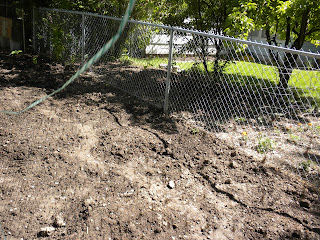


So I spent around six hours last Saturday working on the gardens. I've planted:
- pumpkins
- scallop squash
- three types of cucumber
- peas
- tigger melon (yes, that is Tigger as in Winnie the Pooh)
- carrots
- zucchini
We've still got to put peppers, eggplant, lettuce and tomatoes in the ground. Oh, beans too. I'll do most of that tomorrow.
As I worked, it quickly became clear that the chickens were going to destroy my planting beds and tear up any seedlings. I had to come up with a way to keep them totally out of the gardens. I think what I worked up will function well and is not too terribly ugly. Here:

I put up some tall poles on the edge of the garden. These are left over from the portable carport we used to have that got torn to bits in one of Utah's windstorms. I also lined the entire garden plot with plastic wicker fences that are about eight inches tall at their tallest. I anchored the poles to the fence in several spots. Then I stretched a bunch of bird netting between the poles, tying it off tightly and using garden staples to get the netting close to the ground. From fifteen feet away, our garden looks like what you see above. Here's a corner:

You can sort of make out the netting. I wove some of my heavy duty twine through the top of the netting and tied it off tightly in order to keep the netting from sagging too much. You can also sort of see the planting beds. This is where the cucumbers, squash and zucchini are planted. Should see sprouts in another week.
Here's the other end of the garden:

You should be able to see some mesh, as well as the pumpkin plants. The sun is about 1/2 hour from hitting those pumpkins full on.
The chickens seem to be able to make out the mesh easily; they haven't even tried to go into the garden since I put it up. Here they are-- earning their keep. We haven't had a problem with pill bugs or earwigs since the chickens began spending their days roaming the back yard.

Since Annemarie can't stand earwigs and pill bugs are a bit of a nuisance, I'm accepting this pest elimination by the chickens as a rent payment along with their eggs.
We were also having a problem with the chickens spreading the compost hither and yon. Here's what I did to fix that:

That's just a piece of plywood that I had sitting around. It took me less than five minutes to get this door up. No hinges, just a stake pinning the plywood against the compost frame:

So it's easy to move because it's lightweight and isn't attached. The stake is far enough in the ground that I'm not going to trip on it:

Look at that luscious compost!
Now, one of the issues that needed to be dealt with was how I could protect the garden and still allow access to we homo sapiens. Easily done. I stuck another pole in the ground. I stretched the netting around the corner pole and tied it off to the new pole. Then I made a barrier from the fence to a point a few feet away from the pole. Now we just use a large piece of wood to fill the gap when we want to keep things closed and just move the wood to get in.

It's working well!
Last, I wanted to share an image of my front yard and flower garden.

Our phlox- the pink/purple stuff off to the right-- is just about finishing its blooming cycle. We have four salvia plants, this corner one is blooming like crazy and the other two in the front are getting going as well. There is a huge salvia in the middle of the phlox, but it usually goes later in the season. Salvia is the tall purple flower right in the corner.
We are eating strawberries, harvest chives and parsley, enjoying the yellow/red of the stonecrop, and are stunned at the size of the daisy patch.
The grass, yes, is lovely. I mow every week so I can mulch without a problem. I water for a long stretch about twice a week. Also, it's hard to see them, but we have some nice irises that are gearing up to bloom in front of the house.
So that's the update. We are a little late with the garden this year, but we have high hopes of catching up in the next three weeks.
Incidentally, we have about 25 tomato plants. I'm selling 14 of them, $5 a piece. They are all heirloom. I have a sign out front (it's behind the big salvia). This is a nice way to make a little bit of packet cash
Next time I'll post a clip of how my three-tiered compost works. I'll also discuss strategies for keeping slugs our and getting rid of them and snails when they show up.
Saturday, May 1, 2010
Okay, chickens today.
Raising chickens is all around a good thing. Today we got seven eggs, so it can be a tasty thing too! But were those eggs cheap?
That's the question I want to answer here today.
Getting started with chickens is where the majority of the cost you will expend will happen. Your chickens will need a place that they can stay during the night where foxes, raccoons and rats cannot get to them. This is the same whether you are in suburbs, the country or even in the city.
Your chickens will also need a place that they can lay their eggs, equipment for food and water, and if you have a coop you will want to have something to cover its floor. The also need a sheltered place that they can roost when they go to sleep. You will also need a place to store their food and whatever you will use to cover the floor of the coop and the laying boxes.
So I'm going to show you what we've done. Our city has an ordinance that allows for a few chickens, so we've gone ahead and gotten some. We raised four of the seven from chicks-- the other three were given to us by some friends who had too many.
I won't go into raising chicks today, but I will discuss and show what we've done to maintain the chickens.
We decided that the chickens needed a coop where they could be safe from nightly predators. I spent a lot of time looking for ideas and materials for this coop. We at first thought we might build them a nice house for them to chill in during the evening-- they could wander the back yard during the day. However, building materials and such were pretty expensive- so I decided to do a coop.
I first looked into getting a dog run that I could stretch chicken wire over as a roof. You need a roof because predators like raccoons and rats can climb. Heck, having a floor is a good thing too. We thought a run of about 4-5 feet wide and 8-10 feet long would do well. You can buy these prefabricated at DIY stores like Home Depot and Lowe's.
They were over $200. Add to that the cost of chicken wire and such and it's getting pricey!
But we needed something like a dog run, because we needed to be able to get in and out of the coop easily to get eggs, change water, provide food and do other work.
So I thought about building a coop with 2x4's and chicken wire.
2x4's were a little pricey too.
Then I had this idea that I could build a frame out of pvc, then use zip ties to fasten chicken wire to the frame on all sides, the bottom AND the top. I drew a blueprint, gathered measurements and checked prices. The zip ties were a friend's idea, actually. I could frame a doorway pretty easily and build a door with the pvc too.
The total would be just over $100. This was the best option.
So I built the coop:


Notice it has a door. Most mornings, we head out and wedge the coop door open and build a quick barrier of compressed board between the open door and the house wall. This allows the chickens to come and go between our back yard and their coop as much as they want.
They don't wander much beyond the back yard. Sometimes they will hop a fence, but it's rare.
Anyway, take a look at that coop! It's about 8 feet long and four feet wide. The door is just over 2 feet wide. The coop has chicken wire all over and we bungee the door closed when locking the chickens up for the night.
Notice two white, upside-down buckets with red bottoms. One is their feeder and the other is their water. They usually find bugs and scraps in the back yard, compost and garden plots for the majority of their food, but we like to make sure they have enough to eat. A well-fed chicken is usually a good layer.
See- they wander:

Inside the coop, the chickens have a roosting shed:

The shed is 1/4 inch ply wood, 2x4s, some corrugated roofing and some 1 inch closet rods for roosts. I spent less than $50 and was able to build this shed and the storage shelter I'll show you in a minute. Here's a heads-up, I built the top, sides and back as separate pieces, then assembled the roosting shed inside the coop.
The chickens roosted in this through the entire winter and had no problems whatsoever. Winters here are plenty cold. We used an electric dog water bowl to make sure they had plenty of un-frozen water through the season.
Inside the coop, they also have laying boxes:

This is an old kitchen cupboard. You're looking at what used to be the back. We nailed the doors closed, made the openings in the back much smaller, and fastened rag strips to the openings too. Chickens like a nice private place to lay eggs.
Using this cupboard- which was taking space in our storage basement- was my wife's idea. It was brilliant.
And here's the storage shelter:

The tarp is there because the storage shelter is essentially the same design as the roosting shed- it has an open front. Here's the easy way we get in and out of the storage shed- we hook an the tarp on a nail:

And here's the inside:
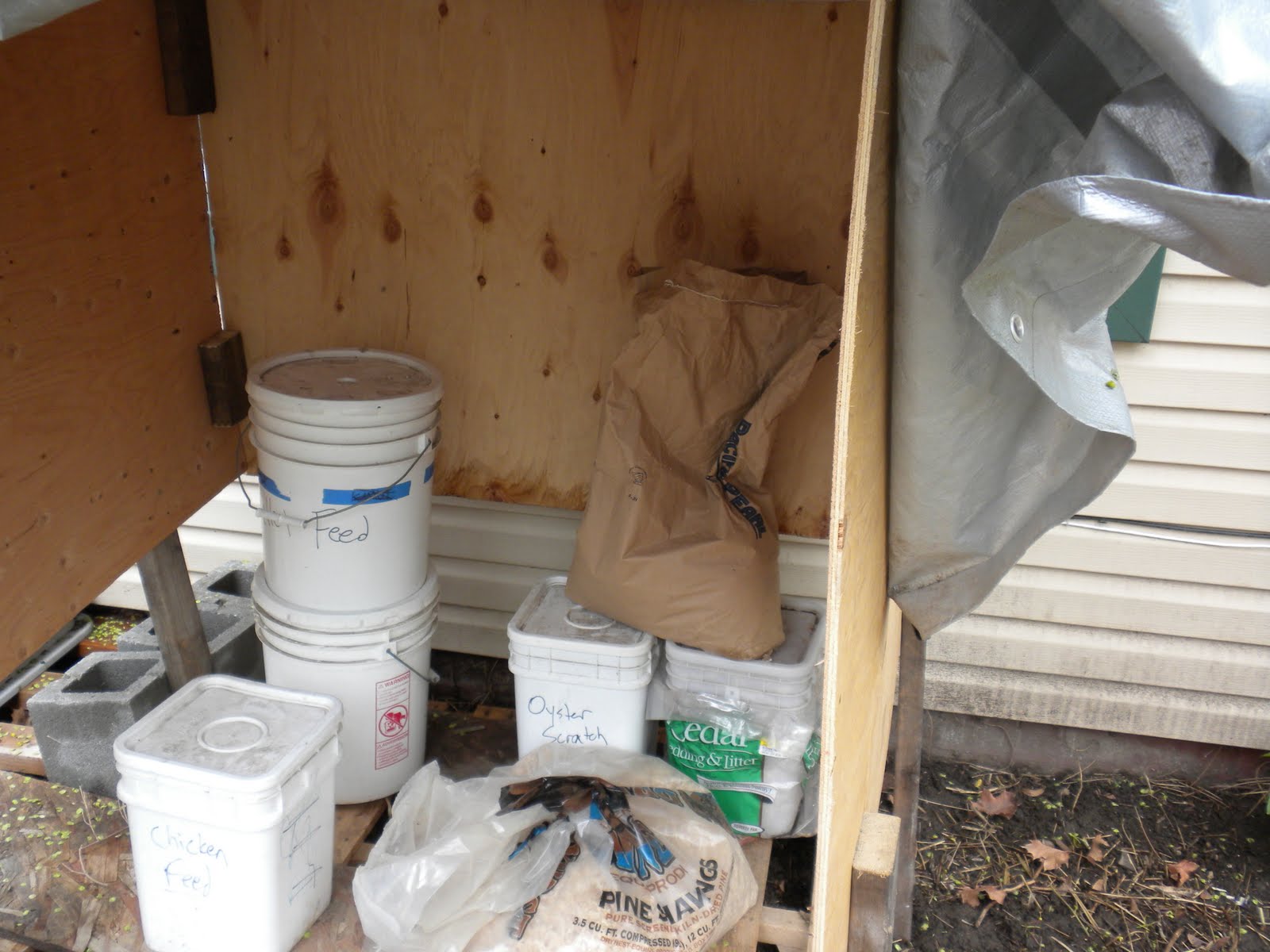
You just don't want your food or material for the coop's floor to get wet. In a few weeks, we will go find a good straw bale and it will get stored in here too.
So that's pretty much the set-up.
Materials for all of this ran about $180 or so. Food is not expensive, although you want to figure in gas cost. The chickens only start laying at about 5 months old, if I remember right.
The point here is that the eggs are not actually cheap. They are delicious. The experience with the chickens is beyond value for us as a family. You never get in a bind and have to go borrow eggs from a neighbor.
And you know what? The chickens are keeping the back yard completely pest free. No earwigs. No pill bugs. No ants even.
We'll talk about chicken care and maintenance in the coming days.
Tuesday, April 27, 2010
Nature's providence
Thought I'd get a job I'd been interviewing for. Found out today that this is just another job, in a series of jobs, that is strangely beyond my grasp.
But on to nature's providence.
First, I'm listening to Promontory off the soundtrack to Last of the Mohicans.
I hope there are moments where you can stop and breathe quietly, taking in the world and its magnificence. If you find yourself wondering what I mean, try this:
*Step outside. Yes, you can do this now.
*No matter where you are standing, you should be able to look up and see the sky.
*What is between you and that vast swath of multi-layered gases up there? Can you feel any wind? Do you know how that wind is made? Do you understand the complexity of the air you are breathing, the interplay between the sun's heat, gravity and the atmosphere and our planet's gravity?
*If you can feel wind, think about skin. The sensations you can feel: smooth, cold, soft, rough, dry, wet, and so on.
*What do you hear? Cars? Birds? Wind murmuring through leaves?
*Atmosphere, wind, skin, gravity, heat. Waves of light, sound, and sensation. The marvelous complexity of a single moment.
*Not such a simple moment anymore.
This is creation: the organization of potential into the knowledge of a moment and a place.
Your garden, lawn and other areas of your stewardship provide opportunities for creation.
Today, I wanted to write a bit about chickens and another area where our labors provide for us.
Here are some chickens:

We have seven chickens. Annemarie, my wife, could tell you what type they are; she provides the majority of their care. I'll spend more time another day discussing what has gone into the getting and raising of these hens, but today I'll just say that they have a good life and we get from three to six eggs a day from them. We have learned a lot from them and they will probably pay for themselves in another six months.
There is something that feels more complete inside when you watch your kids interacting with chickens as the chickens eat pests and weeds. There is something miraculous about a little girl who has a terrible phobia of animals who, when her family raises four chickens from chick to hen, completely and naturally overcomes that phobia. In my heart, these chickens have paid for themselves because my daughter plays with them, cats, dogs and recently had a pet earthworm.
I had an assistant this morning with the chickens. He put on his rubber boots before heading out to the messy coop:

At the coop, he went right to the laying boxes and poked through all of them:

He found one:
 I love my assistant.
Nature provides so much, if we open our lives to it. There is work, much of it repetitive and mundane, but in the very banality of that work are the moments of connection. Connection to creation, to firmament and to life.
Last year we planted two very young fruit trees.
Here is the peach tree:

The cage around it is a tomato cage surrounded by chicken wire. I put this on because in fall of last year, we had deer essentially stripping it down past its bark. I wanted my tree to live, so this has been its protection. It's looking good. The cage will come off soon.
Here's the pear tree:
 It's smaller, but it's doing well so far.
We also have a raspberry bush, still quite young but doing well:

All three fruitful trees/bushes set us back less than fifty bucks total. The fruit, work and connections they will provide are worth far more than that half-benjamin.
It's a great time to put in a fruit tree or bush. I'll discuss how that can be done tomorrow. There is a particular art to it.
My friends, I hope your day is filled with moments of peace and happiness. I also hope you will pass this site along to your friends, family and enemies. If you're enjoying it, so will they.
Until tomorrow.
But on to nature's providence.
First, I'm listening to Promontory off the soundtrack to Last of the Mohicans.
I hope there are moments where you can stop and breathe quietly, taking in the world and its magnificence. If you find yourself wondering what I mean, try this:
*Step outside. Yes, you can do this now.
*No matter where you are standing, you should be able to look up and see the sky.
*What is between you and that vast swath of multi-layered gases up there? Can you feel any wind? Do you know how that wind is made? Do you understand the complexity of the air you are breathing, the interplay between the sun's heat, gravity and the atmosphere and our planet's gravity?
*If you can feel wind, think about skin. The sensations you can feel: smooth, cold, soft, rough, dry, wet, and so on.
*What do you hear? Cars? Birds? Wind murmuring through leaves?
*Atmosphere, wind, skin, gravity, heat. Waves of light, sound, and sensation. The marvelous complexity of a single moment.
*Not such a simple moment anymore.
This is creation: the organization of potential into the knowledge of a moment and a place.
Your garden, lawn and other areas of your stewardship provide opportunities for creation.
Today, I wanted to write a bit about chickens and another area where our labors provide for us.
Here are some chickens:

We have seven chickens. Annemarie, my wife, could tell you what type they are; she provides the majority of their care. I'll spend more time another day discussing what has gone into the getting and raising of these hens, but today I'll just say that they have a good life and we get from three to six eggs a day from them. We have learned a lot from them and they will probably pay for themselves in another six months.
There is something that feels more complete inside when you watch your kids interacting with chickens as the chickens eat pests and weeds. There is something miraculous about a little girl who has a terrible phobia of animals who, when her family raises four chickens from chick to hen, completely and naturally overcomes that phobia. In my heart, these chickens have paid for themselves because my daughter plays with them, cats, dogs and recently had a pet earthworm.
I had an assistant this morning with the chickens. He put on his rubber boots before heading out to the messy coop:

At the coop, he went right to the laying boxes and poked through all of them:

He found one:

Nature provides so much, if we open our lives to it. There is work, much of it repetitive and mundane, but in the very banality of that work are the moments of connection. Connection to creation, to firmament and to life.
Last year we planted two very young fruit trees.
Here is the peach tree:

The cage around it is a tomato cage surrounded by chicken wire. I put this on because in fall of last year, we had deer essentially stripping it down past its bark. I wanted my tree to live, so this has been its protection. It's looking good. The cage will come off soon.
Here's the pear tree:

We also have a raspberry bush, still quite young but doing well:

All three fruitful trees/bushes set us back less than fifty bucks total. The fruit, work and connections they will provide are worth far more than that half-benjamin.
It's a great time to put in a fruit tree or bush. I'll discuss how that can be done tomorrow. There is a particular art to it.
My friends, I hope your day is filled with moments of peace and happiness. I also hope you will pass this site along to your friends, family and enemies. If you're enjoying it, so will they.
Until tomorrow.
Subscribe to:
Posts (Atom)