Okay, so now is a good time for aeration. You might have even had someone come to your door to convince you to pay them to aerate your lawns.
I hope you accepted.
Here's why.
The next time you go to a garden center or a DIY store's garden section, peruse the aisles that deal with lawn care.
As you walk down the aisle of the garden center your eye might be caught by an amazing looking device. It looks like a boot with spikes jutting out of the bottom. Is it an armored soccer or football shoe? No. It is a lawn aerator. But what is the difference between these spikes and the plug method of aeration? And which is better for your lawn? Let's explore some of the going wisdom about this issue.
SPIKES
A spike for your lawn is exactly what it sounds like. It jabs deeply enough into your lawn to get through the grass's root system. Theoretically, this allows air, water and fertilizer access to the roots of your grass, thus making the lawn healthier and greener. However, spikes simply don't cut it on lawns planted on heavy clay or even in very loose soil. Why? Because clay is very resistant and will often seal right up as soon as you slide that spike out. And looser soil will just fall back into the hole, filling it right back up. Spikes take no dirt and no grass out, like plugs, but instead they just make an iffy hole.
PLUGS
Plugs are, once again, exactly what they sound like. They are tiny cylinders of your lawn that are cut and pulled out by a machine. These cylinders leave behind small holes which don't collapse much, if at all. And if loose soil collapsed into these small holes, that would be fine, there would still be a hole left, as the plugs remove a small quantity of soil and grass. What is more, the plugs are left on your lawn to break down and actually provide some nice natural fertilizer for your grass. A small drawback of having plugs taken out for aeration is that these little plugs are indeed left all over your lawn. So for a day or two your lawn might look like a tiny gopher was building a metropolis under your yard. However, the plugs deteriorate fast with water and traffic. And the holes that the plugs leave behind provide good, reliable access for fertilizer, water and air to the root system of your grass.
Which do I recommend for your lawn's aeration? Plugs, all the way. A local grass care company should be able to plug your lawn in a matter of minutes, usually for no more than $20. So leave the insane cleats at the garden center and hurry home to call the aerator guy.
Showing posts with label green. Show all posts
Showing posts with label green. Show all posts
Tuesday, May 4, 2010

Monday, April 26, 2010
Progress report on the lawn
Okay. Part of having a provident garden is being aware of the earth, soil, elements and everything else that might be a part of the ecosystem we are working in. This planet is providing us with the food and other necessities that we have and it is sheer selfish ignorance to not think to the future as we work today.
This is about stewardship, not global warming, so back off Mr. Gore.
I mention this because you might be tempted to call a lawn care company to come in and kill all of the weeds in your garden. Or you might be tempted to get a few packages of chemicals with which to kill weeds and fertilize your lawn.
I believe that we are better stewards when we use the principles of nature to make our lawns look lovely. A lovely lawn is also healthy for us-- it produces loads of oxygen. In fact, a lawn that is 50 feet by 50 feet produces enough oxygen for a family of four. Grass is a very efficient producer of oxygen due to the fact that a plant produces oxygen based on how much of the plant is green. So for a tree, it is the green leaves that do the delicious deed while the trunk does not. For grass, it is the entire blade that makes oxygen.
All of this while reducing carbon dioxide and other bad gases.
I'm not saying grass is better than a tree or two, but healthy, thick, lush grass is very good for your family--better than patchy, struggling grass. And adding chemicals to make a lawn healthier is essentially an oxymoron-- add toxic stuff to reduce toxic stuff.
Meh.
So all this is said to encourage organic and chemical-free lawn care as you make your yard yummy.
Behold:

and behold again:
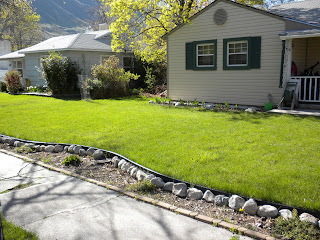
If you compare this to two weeks previous, before I de-thatched, mowed, reseeded and watered regularly:

...you can see that there is some improvement. Yes, the light is different, but the grass is already a little thicker and has a more vibrant color.
Look at the detail. Here is the before detail shot:

and here is the one from two weeks later:

See how the brown patches are disappearing and how the grass is thickening?
No chemicals.
Remember that I first raked this-- which was plenty of work, don't get me wrong.
But remember that I had this assistant:

... so it was made better by how charming little Mr. B. can be.
After raking, I mowed to pick up more debris and get the soil more ready. Then I reseeded with straight seed-- no additives. Since then, I have kept the soil moist by watering a little in the morning and a little in the evening. We also had some rain-which helped.
I won't mow for at least one more week. That will give the seed time to sprout and establish itself better.
I feel great when I see my improving lawn. I feel a deep sense of satisfaction that I have wrought this lovely work of art in partnership with nature-- not opposing it with chemicals and the like. I feel more connected to the earth and the world around me when I water my lawn, standing in the presence of the Wasatch Mountains.
I even get to say hi to the multitude of joggers that pass by while I'm out front.
Provo is replete with joggers. One morning, during my ride to work- which is about a 2 mile, fifteen minute bike ride up a lame hill- I counted over twenty joggers.
Tomorrow, we will talk sustenance. Real sustenance from this land. Specifically: chickens and fruit trees.
Remember to share with your friends, family and enemies!
This is about stewardship, not global warming, so back off Mr. Gore.
I mention this because you might be tempted to call a lawn care company to come in and kill all of the weeds in your garden. Or you might be tempted to get a few packages of chemicals with which to kill weeds and fertilize your lawn.
I believe that we are better stewards when we use the principles of nature to make our lawns look lovely. A lovely lawn is also healthy for us-- it produces loads of oxygen. In fact, a lawn that is 50 feet by 50 feet produces enough oxygen for a family of four. Grass is a very efficient producer of oxygen due to the fact that a plant produces oxygen based on how much of the plant is green. So for a tree, it is the green leaves that do the delicious deed while the trunk does not. For grass, it is the entire blade that makes oxygen.
All of this while reducing carbon dioxide and other bad gases.
I'm not saying grass is better than a tree or two, but healthy, thick, lush grass is very good for your family--better than patchy, struggling grass. And adding chemicals to make a lawn healthier is essentially an oxymoron-- add toxic stuff to reduce toxic stuff.
Meh.
So all this is said to encourage organic and chemical-free lawn care as you make your yard yummy.
Behold:

and behold again:

If you compare this to two weeks previous, before I de-thatched, mowed, reseeded and watered regularly:

...you can see that there is some improvement. Yes, the light is different, but the grass is already a little thicker and has a more vibrant color.
Look at the detail. Here is the before detail shot:

and here is the one from two weeks later:

See how the brown patches are disappearing and how the grass is thickening?
No chemicals.
Remember that I first raked this-- which was plenty of work, don't get me wrong.
But remember that I had this assistant:

... so it was made better by how charming little Mr. B. can be.
After raking, I mowed to pick up more debris and get the soil more ready. Then I reseeded with straight seed-- no additives. Since then, I have kept the soil moist by watering a little in the morning and a little in the evening. We also had some rain-which helped.
I won't mow for at least one more week. That will give the seed time to sprout and establish itself better.
I feel great when I see my improving lawn. I feel a deep sense of satisfaction that I have wrought this lovely work of art in partnership with nature-- not opposing it with chemicals and the like. I feel more connected to the earth and the world around me when I water my lawn, standing in the presence of the Wasatch Mountains.
I even get to say hi to the multitude of joggers that pass by while I'm out front.
Provo is replete with joggers. One morning, during my ride to work- which is about a 2 mile, fifteen minute bike ride up a lame hill- I counted over twenty joggers.
Tomorrow, we will talk sustenance. Real sustenance from this land. Specifically: chickens and fruit trees.
Remember to share with your friends, family and enemies!
Subscribe to:
Posts (Atom)